
Background to the Alexander Grant papers
Patronele McKay, my mother, was born in 1929, the daughter of George McKay, trade union organiser, and Petronėlė Juzė Šugždaitė, a Lithuanian who, as a small child, fled to Scotland with her family around 1902. The Šugžda family lived in the Bellshill and Bothwellhaugh mining villages in the early 1900s, but most of my mother’s Lithuanian uncles and cousins eventually drifted off to the USA between the 1920s and 1950s.
My mother married Iain Craig in 1949, and my parents, and new-born me, emigrated to Australia in 1950. Sometime in the mid 1980s, completely out of the blue, my mother received a letter from an Alexander Grant, once a teenage acquaintance of hers when she lived in Polmadie, Glasgow. Alex was the brother-in-law to one of my mother’s cousins. I became aware at that time, through my mother’s correspondence with him, that this old ‘boyfriend’ (as she described him), had become blind due a to a “terrible medical accident”, and was involved in the study of the Lithuanian language. This language is known to be one of the oldest and most conservative in Europe with links to Sanskrit and Ancient Greek. My mother’s travel diaries included Alex’s address over several years, and I know my parents visited him and his wife, Alice, on 23 March 1992 at his home in Fife, Scotland; my mother died a bit over two months later while still on holidays in Scotland. (See my mother’s diary entry below.) I am almost certain that Alex and Alice attended my mother’s funeral at Falkirk, but I was not introduced at the time.
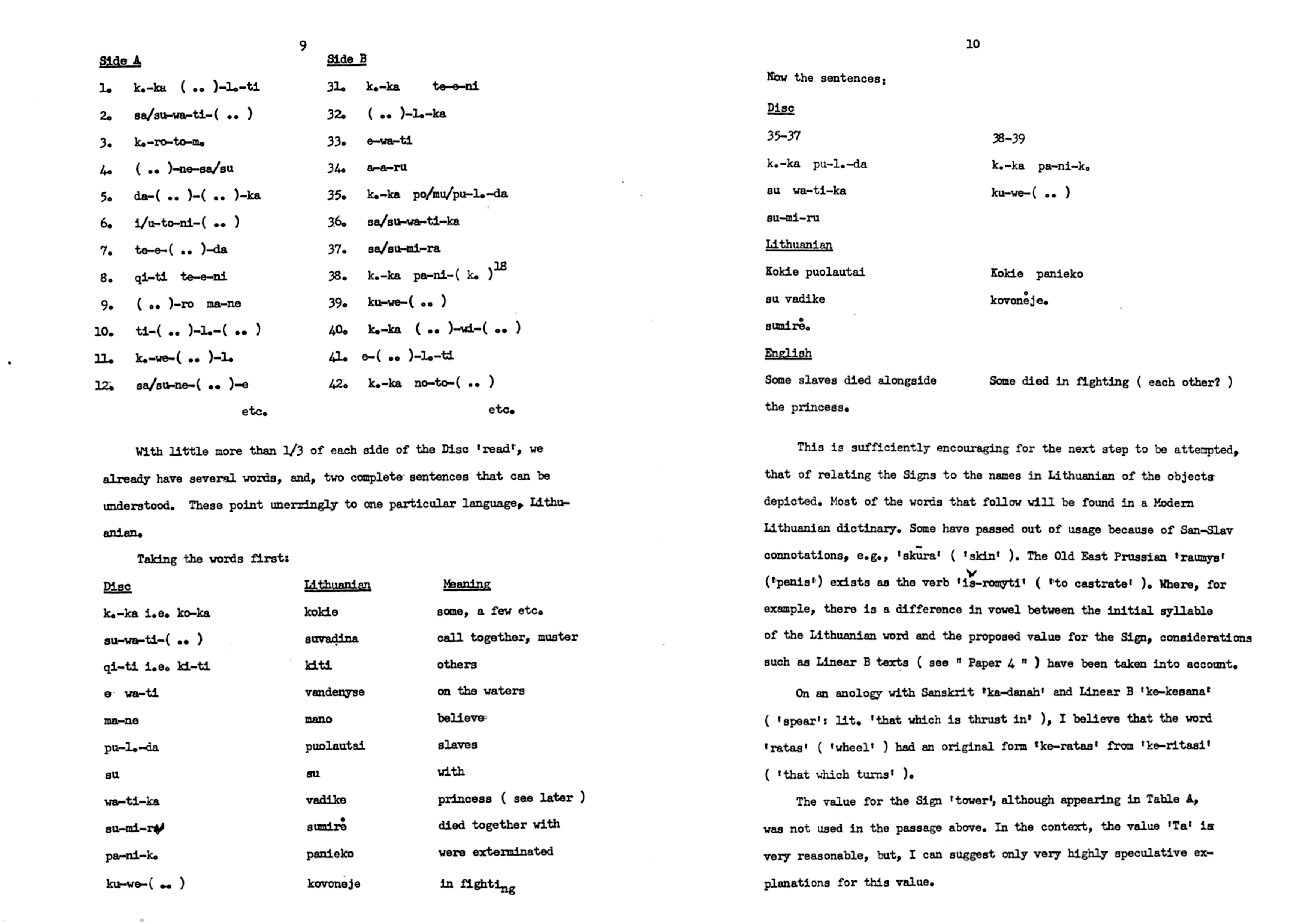
My father eventually passed on my mother’s personal papers (diaries, letters, school reports, etc.) only a couple of years before he died in 2016; I put them in an archive box and stored them away for future study. When I finally found time to look through these papers, I discovered 16 photocopies of two academic papers set out in A5 spreads (sample below): The Phaestos Disc and the Lithuanian Language (1975) and Translation of the Lemnos Stele (1982). My amateur interest in history certainly made me take notice, and it quickly became apparent that Alex Grant was no amateur linguist. It is also apparent from the numbering of these two papers (3 and 5a) that others may have existed — indeed, the text mentions papers 1 to 3, and paper 4.
The photocopies were of original pages put together on an old typewriter. Linguistic studies, and most non-English alphabets, require the use of a multitude of diacritical marks not found on an English-language typewriter, so these had mostly been handwritten on the originals or, in some cases, typed in by skewing the paper on the typewriter roller. Despite the limited technology available to Alex, the documents are reasonably well written, and only contain a small number of grammatical errors. However, as I was a professional editor and book publisher, my immediate impression was that these papers contained serious academic hypotheses that deserved to be formally typeset, and the data entered into proper tables — the following pages are the result of that process. I have kept faith with Alex’s original text and endnotes, but have taken advantage of modern computer technologies not available in the early 1980s. In a few places, where I have been unable to decipher text or identify an image, I have put my best guess in red.
I cannot tell you whether this work has academic merit or not, but the hypotheses look well reasoned to me and, if accurate, would be of value to our understanding of two important ancient artefacts, and a revelation about the history of Indo-European languages. A 1991 letter (reproduced below) from Max Kanowski of the Department of Classics and Ancient History at the University of Queensland attests to this.
However, nearly half a century has passed since Alex developed his hypothesis, and scholars now have a much better understanding of Linear A and B. In 2025, I asked Dr Brent Davis, of Melbourne University to assess the papers I have. Brent has been examining ancient texts using AI to decipher these ancient languages, and his view is that Alex’s work, though done with the highest intensions is unlikely to be accepted by modern archaeologists, linguists, or ancient historians. I have reproduced Dr Davis’ considered view below, and I’m very grateful for the time he gave to seriously examine the Alex Grant papers.
I know that Alex Grant had been a school teacher and lived in Fife, Scotland. Research shows that he was born in Scotland in 1926 of Lithuanian parents as Aleksandras Pridatkas; he died 22 July 1995. He married Alice Spencer Kenneford in 1950 (in Fylde, Lancashire), and I now know they had four children, of whom two survive — these are the heirs to his copyright. I have been in contact with Alexander Grant Jnr., who assures me that if other papers were written, they no longer exist. Alexander and his sister have kindly allowed me to follow up on this important academic study that links previously untranslated ancient texts with the modern Lithuanian language.
Alan Craig, November 2018


Letter from the University of Queensland, St. Lucia, Brisbane, Q4067
7 June 1991
Dear Iain [Craig],
I have read the enclosed and have found it fascinating. I must say the Disc decipherment is more plausible than any other I have seen, and there does seem to be a relationship with the Linear B syllabary.
Unfortunately I know no Lithuanian, which is a drawback in trying to evaluate the results. But I do find the arguments convincing at this stage.
Thank you for showing us the material.
Yours sincerely,
Max Kanowski
Department of Classics and Ancient History
Extracts from my mother’s 1992 travel diary:
Monday, 16 March:
Rang Alex Grant. Monday to Largo.
Monday, 23 March [this entry written by my father]:
Left about 9 […] Drove to Largo – not long (1½ hours) but bit complicated last leg. Surprised so near (overlook) sea. Alex & Alice Grant seemed pleased to see us – had a long natter – Pat’s history – Lithuanian history. (Alex leaves for 3 weeks training with guide dog.) Want us to come again in May/June (we see). Terrible medical muck up caused Alex’s blind[ness] …
Letter from Dr Brent Davis, Melbourne University
==================
Dear Alan,
I’ve read the papers, and they’re very interesting, but there’s a substantial problem here, in that the only concrete way to verify the decipherment of an undeciphered document is to test whether the decipherment works on other documents in the same script … but here, in the Phaistos Disk and the Lemnos Stela, we have two documents that are each unique—no other known document is inscribed in the script of either the Disk or the Stela. Thus verification is quite impossible.
And against this, we have the notion that these two documents—separated in time as they are by a millennium or more—are the only two documents ever found in the entire Aegean Basin that are inscribed in Lithuanian … while at the same time, we have no archaeological evidence at all that the cultures of Lithuanian-speakers were ever present in this region. In his paper on the Lemnos Stela, Grant does say “There are historical reasons, both for the presence of this language in this area at this time, and for its continued existence as a linking living-fossil at the present day. I hope to elucidate these points in future papers.”—but as a professional archaeologist myself of this very region, I’m unaware of any such evidence … and sadly, either Grant never wrote that future paper, or else it hasn’t survived for us to evaluate.
To add to this: I’m not familiar with either Lithuanian or the culture that produced the Lemnos Stela, but the script on the Phaistos Disk is clearly one of the Aegean scripts related to Linear A, the (undeciphered) script of the Minoans on Crete… and there is substantial palaeographic evidence not only that these scripts all shared a great number of signs, but that those shared signs represented the same or similar phonetic values across all the scripts. But looking at Table A in the Phaistos DIsk paper: palaeography has made it clear that the Linear B sign for MA (set in Table A against sign H42) represents a stylised feline head, so it ought to correspond to H29, not H42; while the Linear B sign for QI (set in Table A against sign H15) represents a stylised ram’s head, so it ought to correspond to H30, not H15; and these are only the first two of a long list of similar examples of mismatches between signs on the Phaistos Disk and signs in Linear B that we already know depict the same thing.
So as you can see: the short answer is that (1) Grant’s results are not verifiable in any reliable way, and (2) when taken together with the relevant historical, palaeographical, and archaeological contexts, his results would be viewed quite sceptically by experts in the Aegean scripts—despite the apparently “good fit” of the Disk and the Stela to Lithuanian. You see, it is quite possible to “fit” an undeciphered script to any language one chooses, if one is determined enough … and the telltale symptom is that the “fit” is only approximate, not exact. If you read Grant’s work critically, you’ll see that his transcriptions of these documents resemble Lithuanian … but that is all they do, and that is simply not enough. A single letter of difference can make all the difference in the world—for example, take the following five word-pairs: palatial/palatal, missile/missive, commute/compute, revenge/revenue, torment/torrent. Each pair differs by just a single letter. Do you see my point?
But those who are inclined to base “decipherments” on similarity alone are more numerous than you can imagine. As a specialist in Linear A, I receive a dozen emails a week from people around the globe claiming to have “deciphered” it based on its supposed similarity to a whole raft of languages—Akkadian, Tamil, Ancient Chinese, Estonian, Old Japanese, Irish Gaelic, Hungarian, and on and on and on.
This is why exactness of correspondence—accounting for (and explaining the phonological reasons for) every letter of difference—is so important in a decipherment, along with assiduously taking into account the historical, palaeographical, and archaeological contexts of the document itself. In every convincing decipherment in the past, these things have all matched up admirably, and thereby helped to support the decipherment. But in Grant’s “decipherment”, none of these things match up.
I’m so sorry to be the bearer of bad news. But I fear that Grant’s work, though no doubt done with the best of intentions, really has no hope of being accepted by modern archaeologists, linguists, or ancient historians.
Though I’m sad to report all this to you, I do hope I’ve been helpful in clarifying the situation.
Kind regards,
Dr Brent Davis
Associate Professor of Archaeology and Ancient Egyptian
School of Historical and Philosophical Studies
Arts West, North Wing, Rm 673
University of Melbourne
Victoria 3010, Australia
Comments
Alexander Grant Papers — No Comments
HTML tags allowed in your comment: <a href="" title=""> <abbr title=""> <acronym title=""> <b> <blockquote cite=""> <cite> <code> <del datetime=""> <em> <i> <q cite=""> <s> <strike> <strong>